Looking for ideas for your next trip? Look no further!
Gunma Prefecture, February 2026
A trip by rail and bus taking in Ikaho Onsen and Kusatsu Onsen.
Michael Deveney
2/15/20267 min read
I was trying to think when Gunma suddenly appeared on my radar having previously escaped my attention for my entire life, including the time that I actually lived in Japan. It was probably via one of those YouTube vlogs which reveal unlikely destinations in Japan. It must be said that these non-stop clips are so captivating even if the narrators often aren’t. The door opens to an endless list of new places, there to be explored, minus the wearying soundtrack. These clips have been my primary source for putting together itineraries these last few years – especially in Japan. Subtitles on, sound off, to ensure a calm viewing experience, just type in ‘Gunma’ and take your pick
Well, the first leg of the journey threw up something I have never experienced in Japan before. Trains delayed, one after another! You expect profuse apologies from the station master for a two-minute delay and fear for some anonymous employee hara-kiri in a lonely signal box somewhere up the line, but these delays were of the order of 40 minutes. Imagine! Overhead cables down at Takasaki was the culprit, as the stacked-up Shinkansen came through at intervals, stopping at Ueno Station one at a time. Many people would miss connections further down the line, including us, but Japan’s multi-solution public transport network offers you soothing outcomes at the merest of clicks on your phone. Thus, did we get to Ikaho Onsen a little later than expected but unruffled and unfazed as is the way round here. Note: train after train delayed, with crowds staring forlornly at the platform LED display, but not one curse and nary a hint of impatience.
Ikaho Onsen is known for its 400-year-old stone steps that eventually numbered 365 as of the year 2010 (well, you would put a few more in if you were so close to a whole year’s worth). The town is also known for onsen; in fact, there are 12 hot-spring inns along the stone steps, one for each sign of the zodiac. You can huff and puff your way up from the bottom or join the steps mid-way from your hotel, then go up to the left, knowing that it is all downhill on the way back. A gauntlet of souvenir shops offers you a timely breather as you lumber your way upwards, procession-like. On this occasion in February, it was pretty slow-going on account of the abundant ice, yet to thaw, lying in wait for any steps that were taken in less than a gingerly manner. The patches of snow and ice on adjacent steep roads were also ready to seize upon any careless misstep. When you think about it, if a town has hundreds of steps running up the middle of it, likely as not every street will be on some incline or other, especially the twisty-turny ones of which there are many. This is not the place to practise hill-starts in your clapped-out Mini. Evening on the steps was just as enchanting as daytime, with strings of lights adding a golden hue to the fairytale backdrop. Not many folks were out and about at 7pm though – all gone home or not up to a cold starry evening at -4C?
The hotel there was quirky to the foreign eye, although probably seen as quite unremarkable to local guests. Check-in was overseen by three ladies who fussed and fluttered while explaining all the rules via a phone translator. Book your private onsen and put your sticker on the board here, dinner is on the third floor up there, showers are on the second floor by the drink machine over there, here is your yukata, your towel and your little bag full of useful things (?!), put your shoes there where your room number is taped to the floor and so on. Wandering to the lift (Which way is the lift, again?), it was all you could do to remember your name as ‘information overload’ flashed before your eyes. Both dinner and breakfast were comprised of lots of little dishes of things that were not recognisable to non-Japanese. It was a case of probing with chopsticks and finding out which ones pleased the palate – not many. A big plus-point was the private onsen on the balcony looking across towards the mountains at dusk. Tip-toeing barefoot over patches of snow to sit in a very hot bath while taking in the air at a minus something temperature was novel, to say the least.
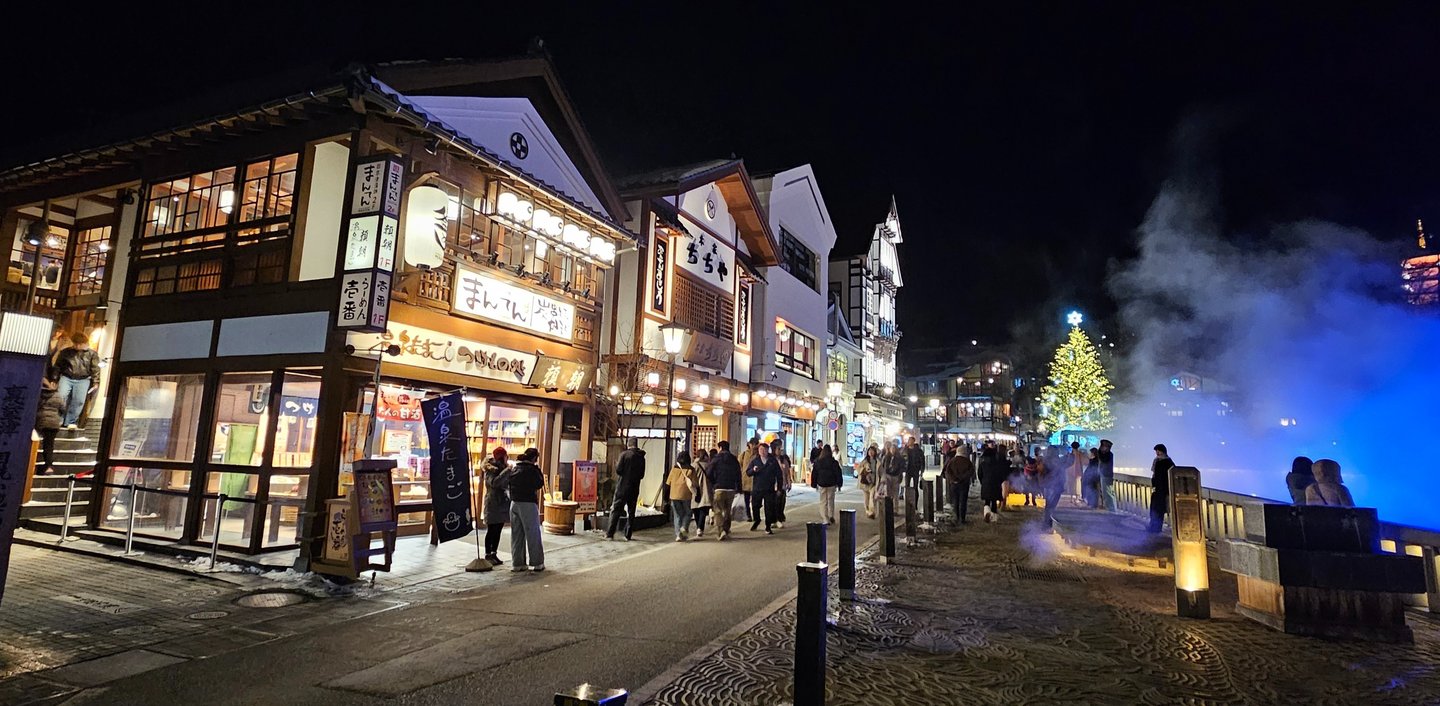
To get to Kusatsu Onsen, where we were going next, it was a case of coming south-east down the valley by bus, getting a train further north, then going back up a different valley north-west, again by train, before waiting for another bus. So, it was bus-train-train-bus. These aren’t bookable online, so it is a matter of cramming in with fellow travellers as best you can. The first train was packed and the second fairly busy, such that there were four large buses waiting for the final leg to Kusatsu. All good. This being a Tuesday, one would have expected to have avoided the crowds, but it was busy with young folks away for a couple of days (judging by the small bags) and mainly young couples or groups of young girls for some reason. I guess they know the reason. And fair do’s because Kusatsu Onsen is a pretty town centred around a bubbling turquoise hot spring pond which decants waters into a series of wooden cooling troughs before spilling downhill and disappearing underground. Steam comes up through every grating, adding a sulphurous whiffy atmosphere, and all this is surrounded by bijou souvenir shops and eateries. Even the lanes which wind their way up the slopes are picturesque. The street lighting at night makes for even more insta-worthy shots. The hotel here, by the way, went the extra cleanliness mile with a lady thoroughly wiping down each wheel on each suitcase before entrance across the threshold was deemed to be safe. I hope they get a certificate for that!
How can you take a dip, given that the waters naturally flow at about 50C? Cooler water is added for the various onsen dotted about and each hotel has a private onsen option too; sign up or first come first served, depending on the house rules. The customary way of cooling down the water is called the Yumomi Ritual. Big wooden paddles are flipped this way and that to stir the waters, sometimes with an extravagant down-and-up to send a torrent up into the air. All this is conducted while chanting a traditional folk song in step with the rhythm of the swishing paddle boards. This practice has been going for hundreds of years and is now commemorated with a show, six times per day, as the ladies twirl their boards to thrill the crowds. A front seat for this one required getting to the ticket kiosk well early, thus ensuring a close-up of proceedings – including such detail as the ladies’ soaked yukatas! The waters at Kusatsu Onsen, by the way, are said to cure all known maladies except lovesickness. Nothing but time can remedy that one; sometimes a long time indeed!
The final part of this trip fizzled a little with the main feature a side-trip to Takasaki in order to visit the Haruna Shrine on the lower slopes of Mount Haruna, a stratovolcano that stands at 4,754’ high. I have encountered this problem frequently – that is, the absence of any English on bus stops or bus schedules. I am not making an issue about spoken English or signage in general (which is far better in Japan than portrayed in the media), but just the name of the destination would be all that is required to prevent you having to hop onto bus after bus to quickly quiz the driver as to where he is headed. This almost never works, as he is just about to start and doesn’t need the distraction, and of course, he can’t make sense of your garbled pronunciation. Long story short – there are two Haruna Shrines and we went to the wrong one after trying several buses outside the main station. As we were going along, I did think it looked rather flat compared to the pictures I’d seen! Being dropped off in the middle of nowhere at a bleak, windy bus-stop, surrounded by fallow fields, ushered in only one thought: “This isn’t it!” Well, two thoughts: “How do we get back?” Oh well, can’t win them all. I do know that you can point the camera on Google Translate at a bus schedule, but time was of the essence and with bus engines idling there was pressure to just get on with it.
As usual the last stay before the flight home was in Makuhari, where we used to live. It is always good to walk the streets of a former residence. I don’t know why but it is reassuring and it’s nice to end a trip on a positive note, surrounded by familiar sights. This is a similar feeling to visiting the street where you grew up after decades of absence. You stand there in front of your old house, take a photo, and embrace the warm, fuzzy feeling, only for it to evaporate the second you leave the street. You then get on with your present-day life, thus consigning the moment to the past; that place where all the other memories are filed. Touching on the topic of time elapsing, I bumped into a former colleague and sat down for a decent catch-up, during which it transpired that I left my job in Japan eight years ago. I hadn’t realised that; it seems like about four. Time really does speed up as you advance in years!
Highlights? Kusatsu Onsen was better than expected, especially the atmosphere on a winter’s night. I suspect you do need to choose your day of the week carefully if you want to avoid the crowds; it sure looks like ‘heaving’ would be somewhere on most of the postcards sent from there in whatever language. Gunma is certainly worth checking out and it would be easy to put an itinerary together for a long weekend away from Tokyo or as a stopover on the way to Niigata. Finally, a kind of geography observation – when you look at the map you notice that Kusatsu Onsen is quite near to Jigokudani Monkey Park in Nagano where the snow monkeys loll about in the hot springs. Thoughts of a combined trip soon fade when you realise that you can’t go over the mountains in winter, the way round connecting the two is actually a six-hour journey! Next time, perhaps.